
Territorial Acknowledgement
NAPRA primarily works from Ottawa, which is located on the traditional and unceded territory of the Anishinaabe Algonquin Nation. The peoples of the Anishinaabe Algonquin Nation have lived on this territory for millennia. Their culture and presence have nurtured and continue to nurture this land. We honour the peoples and land of the Anishinaabe Algonquin Nation and strive to stand in solidarity and reconciliation with them. As the alliance of the provincial and territorial pharmacy regulatory authorities across Canada as well as the Canadian Forces Health Services, we acknowledge the ancestral and unceded territory of all Inuit, Métis, and First Nations peoples that call this land home. We honour them and their past and present stewardship of this land.
This report highlights progress made in 2025, which marks Year 2 of the implementation of NAPRA’s 2024-2028 Strategic Plan, in the strategic areas identified as critical to advancing the association’s central purpose of providing the best possible support to its Members – the pharmacy regulatory authorities (PRAs) across Canada as well as the Canadian Forces Health Services – as they focus on their primary mandate of protecting and serving the public interest.
Significant activities undertaken in 2025 include:

Completing research on models for licensure and labour mobility nationally and internationally.
Facilitating discussions to inform NAPRA Members’ work as they continue to explore role definitions for pharmacy professionals.
Engaging with interested parties at the federal, national, pan-Canadian, and international levels on behalf of NAPRA Members.
Progressing NAPRA’s work on its updated suite of model documents for PRA use on non-sterile and sterile compounding standards.
Coordinating a community of practice for PRAs across Canada to address common issues and share knowledge and experiences relevant to pharmacy regulation, including hosting 13 PRA Roundtables and several information-sharing sessions related to NAPRA’s compounding documents, quality assurance, emerging technologies, registration and licensure, and cross-jurisdictional issues.
Maintaining the National Drug Schedules (NDS), including regular updates to the NDS listings and review of two drug scheduling submissions by the National Drug Scheduling Advisory Committee (NDSAC).
Advancing work on the NDS Modernization Project.
Managing Pharmacists’ Gateway Canada, which has registered a total of 37,217 international pharmacy graduates since its establishment in 2014.
NAPRA’s 2025 outcomes would not be possible without the remarkable team of committed Board members, staff, and experts who support various NAPRA initiatives. NAPRA is grateful for their dedication and generous contributions.


About NAPRA
Visit the About NAPRA page for background information on NAPRA, including who we are, what we do, and our current Board of Directors.
Previous years’ annual reports are also available to view from the NAPRA Annual Reports page.
This short presentation highlighting the respective roles of NAPRA and its Members as well as NAPRA’s programs and services to its Members and its impact on pharmacy practice in Canada also provides an excellent introduction to the organization and its work.
NAPRA’s Board of Directors is elected in the spring of each year. In May 2025, the following Board of Directors was elected to serve until May 2026.
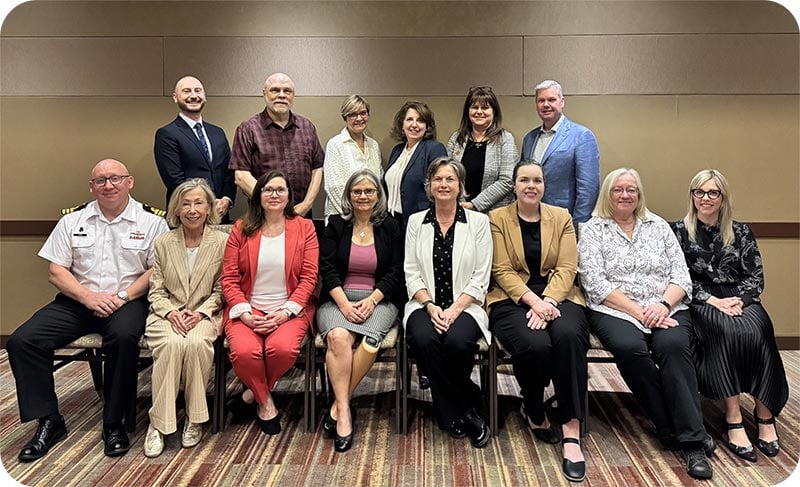
Back row – from left to right: Kevin Hamilton, Vice Chair (College of Pharmacists of Manitoba); Larry White (Government of Northwest Territories – Department of Health and Social Services – Professional Licensing Office); Susan James (Ontario College of Pharmacists); Christine Thomas (external Director); Suzanne Solven (College of Pharmacists of British Columbia); Brad Willsey (Alberta College of Pharmacy).
Front row – from left to right: Randy Tuff (Canadian Forces Health Services); Debbie Fischer (external Director); Michelle Wyand, Chair (Prince Edward Island College of Pharmacy); Adele Fifield, NAPRA CEO (ex-officio); Bev Zwicker, Past Chair (Nova Scotia College of Pharmacists); Lindsay Mell (New Brunswick College of Pharmacists); Barbara Harvey (Government of Nunavut – Department of Health); Noelle Patten (College of Pharmacy of Newfoundland and Labrador).
Not pictured: Jeana Wendel (Saskatchewan College of Pharmacy Professionals); Manon Lambert (Ordre des pharmaciens du Québec); Robert Solek (external Director); Steph Connolly (Government of Yukon – Community Services – Professional Licensing and Regulatory Affairs).

NAPRA 2024-2028 Strategic Plan: Year 2
Building on past progress and articulated around a keen understanding of the most pressing issues facing its Members, NAPRA’s 2024-2028 Strategic Plan marked the beginning of a new era, outlining clear priorities for action in strategic areas that continued to drive the association’s focus in Year 2 of the 5-year plan. These included facilitating a national dialogue on key facets of pharmacy regulation in Canada; engaging with Health Canada and other key national, pan-Canadian, and international organizations; and centrally coordinating major programs and initiatives on behalf of NAPRA’s Members. Progress made in 2025 in each of these areas is highlighted below.

Strategic Area #1: National Dialogue on Key Facets of Pharmacy Regulation in Canada
In recent years, governments at all levels have placed greater emphasis on facilitating labour mobility across Canadian jurisdictions for health professionals and streamlining the licensure of internationally trained health professionals. As the regulatory authorities for pharmacy in Canada, NAPRA’s Members play a leading role in efforts to tackle the challenges associated with cross-jurisdictional movement of pharmacy professionals and accelerated foreign credential recognition for international pharmacy candidates while continuing to safeguard patient safety. NAPRA completed work in 2025 researching models for licensure and labour mobility nationally and internationally, including a review of the literature and discussions with relevant parties.
A related key issue in the efforts to support quality pharmacy care across the country is discussion around the role of the pharmacist and pharmacy technician within the Canadian healthcare system. The working group established for this purpose held discussions in 2025 around the role of pharmacy professionals in Canada and the possible development of national role definitions to support various aspect of the work of NAPRA and its Members.

Strategic Area #2: Strategic Engagement

As the national alliance of all Canadian pharmacy regulatory authorities (PRAs), NAPRA is uniquely positioned to represent its Members on behalf of whom it engages with various interested parties at the federal, national, pan-Canadian, and international levels.
A core focus of NAPRA’s activities involves engaging with Health Canada and other relevant federal departments to ensure that the perspectives of NAPRA Members are reflected on pertinent issues. In 2025, this included various meetings and other forms of engagement with Health Canada officials and/or staff to discuss and share NAPRA Members’ views on three topics identified as being of key significance to NAPRA’s Membership: Federally Enabling Pharmacists as Prescribers of Controlled Substances, Outsourced Drug Preparation, and Licensure Mobility. In relation to the latter, NAPRA also responded to a Health Canada consultation regarding the development of regulations under the Free Trade and Labour Mobility in Canada Act.
Additionally, NAPRA provided input into a variety of other Health Canada consultations, including on:
- Precursor chemicals and designated devices
- Drug shortages
- Nicotine replacement therapy
- Non-prescription cannabidiol
- Clozapine Controlled Distribution Program
- Non-prescription drug (NPD) regulatory modernization
In 2025, NAPRA also participated in various Health Canada meetings on topics such as drug shortages, importation of active pharmaceutical ingredients for compounding, nicotine replacement therapy, lomustine discontinuation, pharmacist authority during oxycodone/acetaminophen shortage, compounding of glucagon-like peptide-1 (GLP-1) agonists, natural health products (NHP) labelling, NPD regulatory modernization, as well as general update sessions.
NAPRA continued to engage with various non-governmental organizations on matters of mutual interest at the national, pan-Canadian, and international levels.
Highlights of engagement activities undertaken with non-governmental organizations in 2025 include:
NAPRA participation on external committees and boards of interested parties such as the International Pharmaceutical Federation’s Regulators Advisory Group (FIP RAG), the Canadian branch of the Alliance for Safe Online Pharmacies (ASOP Canada) as observer, and the Canadian Council for Accreditation of Pharmacy Programs (CCAPP). NAPRA also participated in the National Association of Boards of Pharmacy (NABP) .Pharmacy Executive Committee meeting as well as ASOP Global meetings.
Close collaboration through the year with PRAs and the Pharmacy Examining Board of Canada (PEBC).
Facilitation of connections and consultation on various issues between NAPRA Members and organizations of interest, including PEBC, CCAPP, the Canadian Pharmacists Association (CPhA), the Canadian Society of Healthcare-Systems Pharmacy (CSHP), and Food Health & Consumer Products of Canada (FHCP).
Engagement with key interested parties – including CCAPP, PEBC, CPhA, the Association of Faculties of Pharmacy of Canada (AFPC), the Canadian Pharmacy Technician Educators Association (CPTEA), and the Canadian Association of Pharmacy Technicians (CAPT) – on the PRA Approach to Compounding Competence, as well as with Canadian Blood Services and NABP on NAPRA’s compounding work.
NAPRA attendance at the CPhA Pharmacy Disruptors 2030 Summit, the CSHP Professional Practice Conference (PPC) 2025 – at which NAPRA presented on compounding standards development, and the FIP Congress in Copenhagen, Denmark, prior to which the NAPRA CEO took part in a multi-day study tour of key organizations in London, England.
Provision of NAPRA input for consideration for programming for the FIP Congress being held in Montreal in 2026.

Strategic Area #3: Central Coordinating Role
NAPRA’s central coordinating role includes providing continued support to its Members with the implementation and maintenance of major programs and initiatives requiring a national lens, such as producing model documents for Members to use as desired, facilitating the pharmacy regulatory authority (PRA) community of practice and knowledge sharing, and centrally managing the National Drug Schedules and Pharmacists’ Gateway Canada.
NAPRA Documents

NAPRA develops and publishes model documents that PRAs can use as desired, based on their specific needs. Given this, there can be slight differences between jurisdictions, and pharmacy professionals are responsible for knowing and adhering to the requirements in the province(s)/territory(ies) in which they practise. National documents help to align requirements across the country and reinforce their credibility, dependability, and acceptance throughout Canada. This contributes to the delivery of consistent quality care from coast to coast.
In 2025, NAPRA progressed its work to update its suite of model documents for PRA use on non-sterile and sterile compounding standards. The goal of the project is to update the documents to better align with the outcomes-based approach taken for other NAPRA model documents, update the content based on current evidence-informed references, address any issues/concerns with the current documents, and ensure the documents reflect current and anticipated future pharmacy practice.
Pharmacy Regulatory Authority Community of Practice and Knowledge Sharing

NAPRA facilitates regular PRA Roundtables with the aim of supporting information sharing and collaboration among its Members. Thirteen such meetings were held in 2025.
NAPRA also administers and hosts regular information-sharing meetings on various areas of interest that are continually updated. In 2025, NAPRA hosted several information-sharing sessions related to its suite of compounding documents. Meetings of the Quality Assurance, Emerging Technologies, and Registration and Licensure Information-sharing Groups as well as one Cross-jurisdictional Roundtable were also held over the year.
National Drug Schedules

Health Canada, NAPRA, and the provincial/territorial governments each have distinct roles related to drug scheduling in Canada. Health Canada has the authority and responsibility to authorize health products (e.g., drugs, natural health products, and medical devices) for sale in Canada. As part of this process, Health Canada determines whether a drug requires a prescription for sale in Canada. NAPRA’s role in the process begins after Health Canada has authorized a drug for sale in Canada and determined whether it requires a prescription for sale.
On behalf of its Members, NAPRA administers the National Drug Schedules (NDS) program, a national drug scheduling model established with the aim of aligning the provincial/territorial drug schedules so that the conditions of sale for non-prescription drugs would be more consistent across Canada. The NDS consist of three schedules / four categories of drugs.
Managing National Drug Schedules Operations
In 2025, NAPRA continued to effectively manage the ongoing operations of the NDS program. Regular updates to the NDS were completed to align with changes to the Health Canada Prescription Drug List (PDL) and schedules to the Controlled Drugs and Substances Act (CDSA) and its regulations, as well as changes due to National Drug Scheduling Advisory Committee (NDSAC) review decisions.
The NDS were modified in January 2025, pursuant to scheduling decisions made at the NDSAC meeting held in December 2024 to review cetirizine for use in children 2 to 11 years.
The NDSAC reviewed two drug scheduling submissions in 2025. The NDS were modified following a review of non-prescription esomeprazole 20 mg in June.
A meeting was also held in December 2025 to review acetaminophen and ibuprofen, when sold in oral, fixed-dose combinations. The Committee’s recommendations regarding this scheduling submission were to be approved by the NAPRA Board of Directors in early 2026.
National Drug Schedules Modernization Project
Work on Phase 1B of the NDS Modernization Project was launched in 2023 with the objective of determining the most appropriate drug scheduling model for the future (including conditions of sale). After extensive work in 2023-2024 – including background research and environmental scanning activities, numerous engagement activities with select groups of experts, and a broad public consultation on two proposed non-prescription drug scheduling models and associated conditions of sale for consideration for the modernized program – a recommended model was reviewed and accepted by the NAPRA Board of Directors in January 2025, thus completing Phase 1 of the project.
Phase 2A of the modernization project was launched in spring 2025 with the goal of sharing information on the project and key topics with the provinces and territories and obtaining their preliminary feedback. In that regard, background reports were completed and shared with provincial and territorial governments regarding funding, legal authority, enforcement in non-pharmacy outlets, harmonization of the NDS program, and the role of other health professionals. Exploratory discussions were subsequently held with a majority of provincial/territorial governments, with the rest to follow in early 2026.
Pharmacists’ Gateway Canada

International pharmacy graduates (IPGs) who wish to practise pharmacy in Canada (except those in Quebec and those who are eligible for the streamlined/expedited pathways offered in Manitoba, New Brunswick, Newfoundland & Labrador, Nova Scotia, and Prince Edward Island) must enrol in Pharmacists’ Gateway Canada for International Pharmacists (Gateway) as their first step in the process to become a licensed pharmacist in Canada. NAPRA administers and maintains Gateway in support of its Members, who are responsible for regulating all pharmacists in Canada.
The public-facing part of the Gateway website provides pertinent, clear, and complete information to the thousands of IPGs each year seeking to learn how to become licensed pharmacists in Canada. Gateway guides applicants through every step in the licensure process for each province and helps IPGs identify the requirements that can be completed before their arrival in Canada.
In addition, Gateway provides tremendous value not only to IPGs but to all other parties involved in the licensure process – i.e., pharmacy regulatory authorities (PRAs), the Pharmacy Examining Board of Canada (PEBC) – as it establishes a central national document repository to support seamless communication among all concerned.
Gateway welcomed 4,641 newly enrolled IPGs in 2025. Since Gateway’s inception in August 2014, a total of 37,217 IPGs had enrolled in the program by the end of December 2025.

The Gateway team provides direct support, by phone and email, to IPGs as they progress through the various stages of the licensure process and to others interested in the licensure process. In 2025, the Gateway team responded to 4,985 inquiries, of which 78% were via email and 22% by phone.
The NAPRA Diagnostic Tool and Learning Modules (DTLM) is an online learning program that addresses participants seeking to increase their understanding of the knowledge and skills required for pharmacy practice in a Canadian setting and/or are preparing to meet the requirements of the PRAs for licensure in their respective jurisdictions. A total of 130 participants enrolled in the program in 2025.
The Gateway team maintained ongoing engagement with PRAs across Canada and the PEBC throughout the year, facilitating information sharing and coordinated efforts to support IPGs pursuing licensure.
Threaded throughout NAPRA’s 2024-2028 Strategic Plan is the need to ensure NAPRA’s organizational capacity to continue to ably support its Members as they work to protect and serve the Canadian public interest through effective pharmacy regulation in their respective jurisdictions.

NAPRA 30th Anniversary
In 2025, NAPRA proudly marked its 30th anniversary, celebrating three decades of advancing pharmacy regulatory excellence. This milestone underscored the association’s ongoing commitment to providing strong support to its Members – the pharmacy regulatory authorities (PRAs) across Canada – as they carry out their primary mandate to protect and serve the Canadian public interest through effective pharmacy regulation in their respective jurisdictions.
As NAPRA reflected on key achievements from its first 30 years, it also renewed its focus on strengthening its critical role as the alliance of pharmacy regulators in Canada and increasing its value to Members in a continually evolving regulatory landscape.